
Belong First, Then Become
The things you hid to fit in are the exact things that will make you stand out

Fitting in is not a weakness. It might be the smartest thing you did early in your career.

You learned the room. How people talk in meetings. What gets rewarded quietly. Which opinions are safe and which ones make people uncomfortable. You matched the tone. You held back the instinct that didn’t fit the culture. You kept the weird question to yourself.
And it worked. You got trusted. Included. Promoted, even.
But somewhere along the way, you got so good at fitting in that you forgot what you sound like without the filter.
The things you learned to hide are the things that would make you impossible to ignore.
The filter
Everyone builds one. It’s not a flaw. It’s survival.
You walk into a new company, a new team, a new room, and you read it instantly. What’s the energy here. Who talks first. What kind of ideas get nodded at. What kind get silence.
So you adjust. You learn to package your thoughts in the format the room accepts. You drop the sharp observation and replace it with the safe one. You hold back the “this doesn’t make sense” and say “interesting, let me think about that.”
That filter got you in. It earned you trust. It was the right move. But the filter doesn’t know when to turn off.
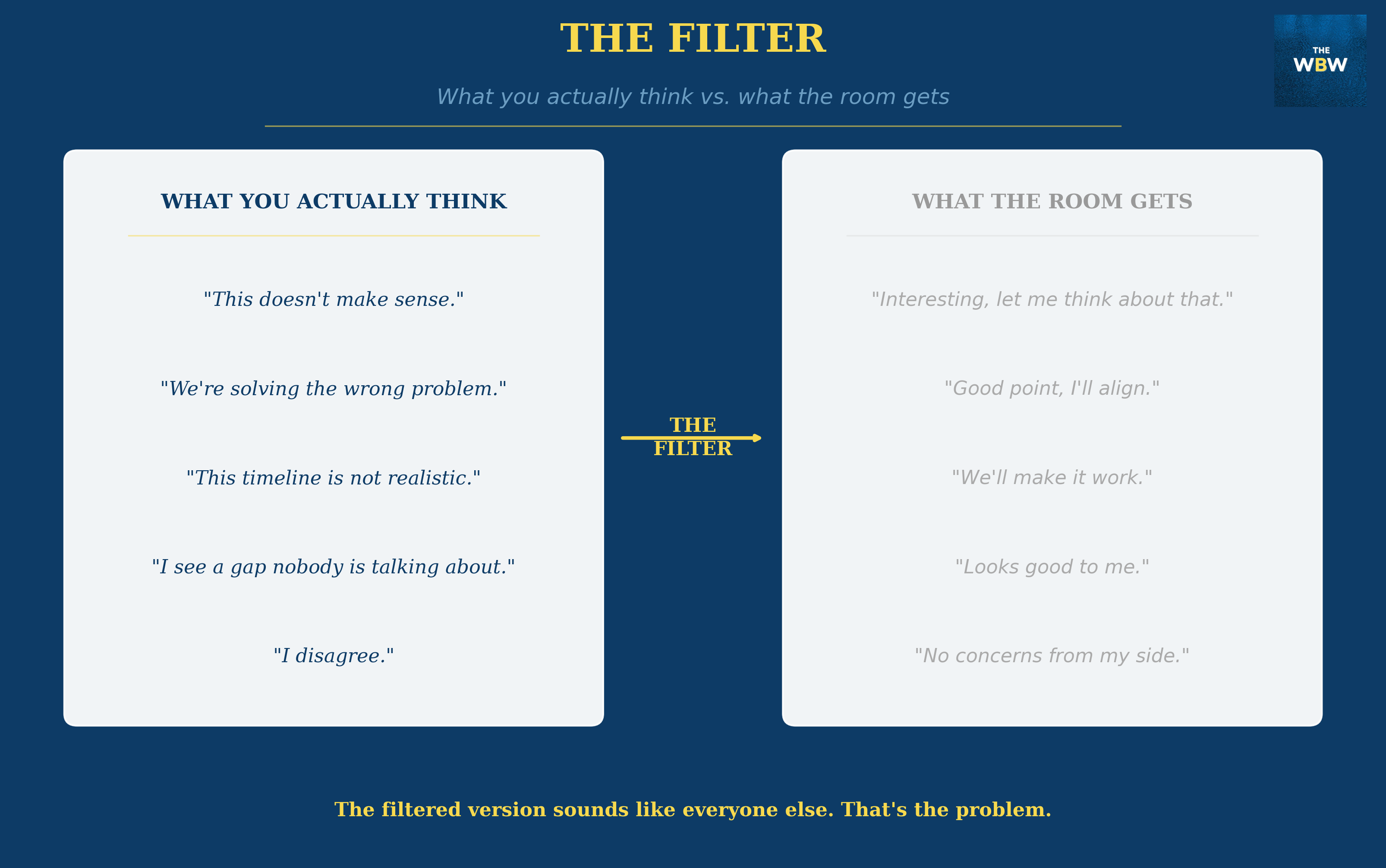
So here you are. Years in. Trusted. Respected. Included in the right meetings. And yet somehow... forgettable. Not because you lack talent. Because the room gets the filtered version of you. And the filtered version sounds like everyone else.
Being trusted is phase one. Being distinct is phase two. Most people never leave phase one because it feels safe enough to stay.
The experiment
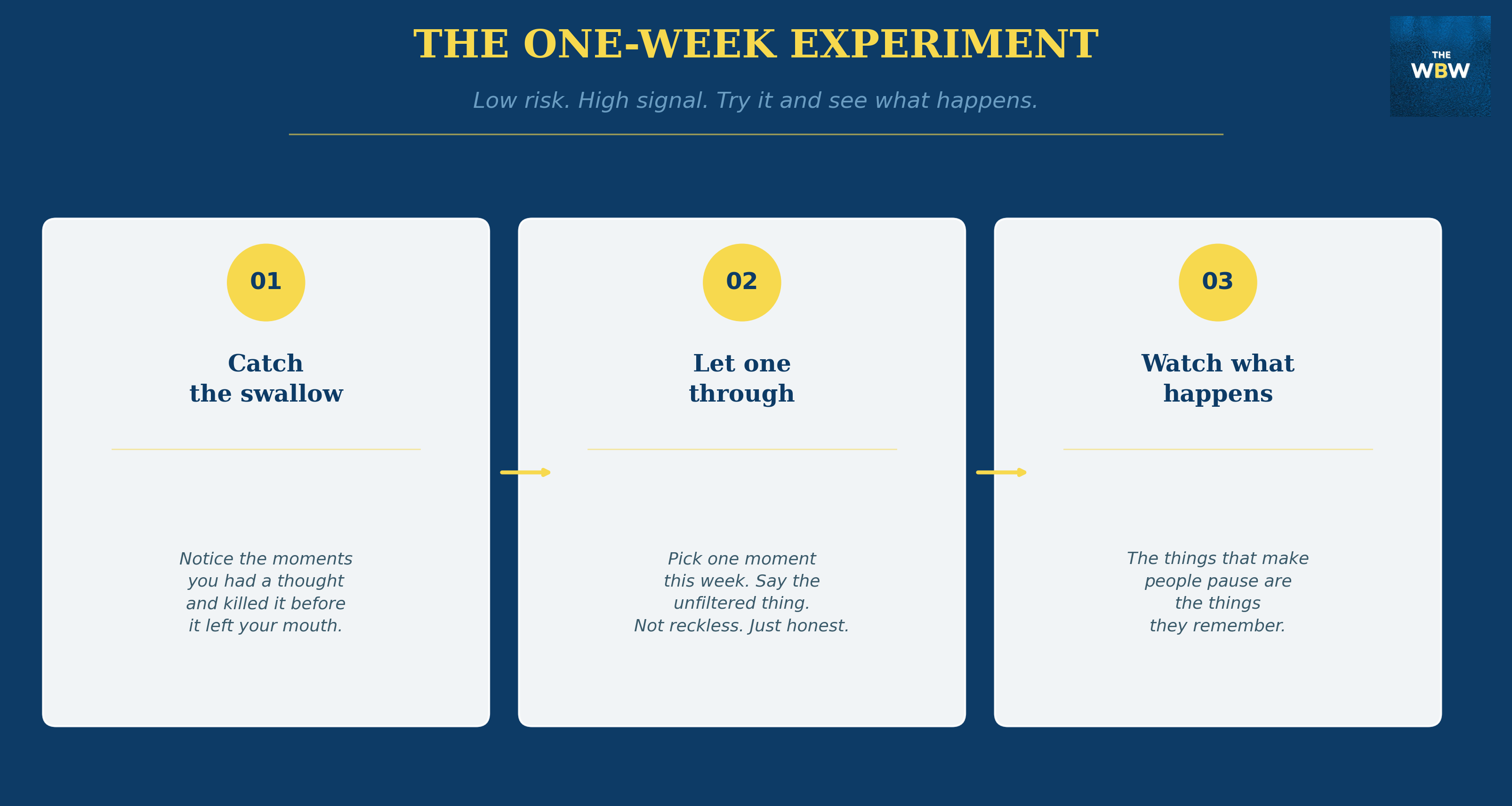
This isn’t a framework. It’s a one-week experiment. Light. Low risk. Try it and see what happens.
1. Catch the swallow
Once a day, notice the moment you had a thought and killed it before it left your mouth. In a meeting. On a call. In an email you rewrote three times to sound safer. Don’t do anything about it yet. Just notice how often it happens.
Example: “My director presented a plan and I immediately saw a gap. I almost said something. Then I thought ‘it’s not my place’ and nodded instead. I’ve been doing this for months.”
2. Let one through
Pick one moment this week where you say the unfiltered thing. Not reckless. Not aggressive. Just honest. The thought you would normally polish until it sounds like everyone else’s.
Example: “In a project review, instead of saying ‘looks good,’ I said ‘I think we’re solving the wrong problem here. The client’s real issue is onboarding speed, not the dashboard.’ The room went quiet. Then my manager said ‘say more.’ That never happens when I play it safe.”
3. Watch what happens
Pay attention to the reaction. Not the immediate one. The one that follows. Does someone bring it up later? Does your manager reference it? Does someone come to you after the meeting?
The things that make people pause are the things they remember.
Example: “I pushed back on a timeline in a team call. Nothing dramatic. Just said ‘I don’t think this is realistic and I’d rather flag it now than scramble later.’ Two days later my manager asked me to lead the replanning. That came from one honest sentence.”
Why this matters
You didn’t build that filter by accident. You built it because it worked. And now you’re good enough, trusted enough, and established enough to start taking it off.
Not all at once. Not everywhere. Just enough to remind the room that there’s a person behind the professional. A perspective behind the polish. A point of view that nobody else in that room has.
You earned the right to be here. Now let them see who “here” actually got.
The work behind work isn’t just fitting in. It’s knowing when to stop.
This is the work behind work.
Kenza