
Mark to Market
The gap between what you think you’re worth and what the market would pay.

In finance, mark to market means one thing: revalue the asset at today’s price. Not what you paid for it. Not what you hope it will be worth next year. What someone would pay for it right now, in the current market, with current information.
It’s the most honest number on any balance sheet. And most professionals have never run it on themselves.

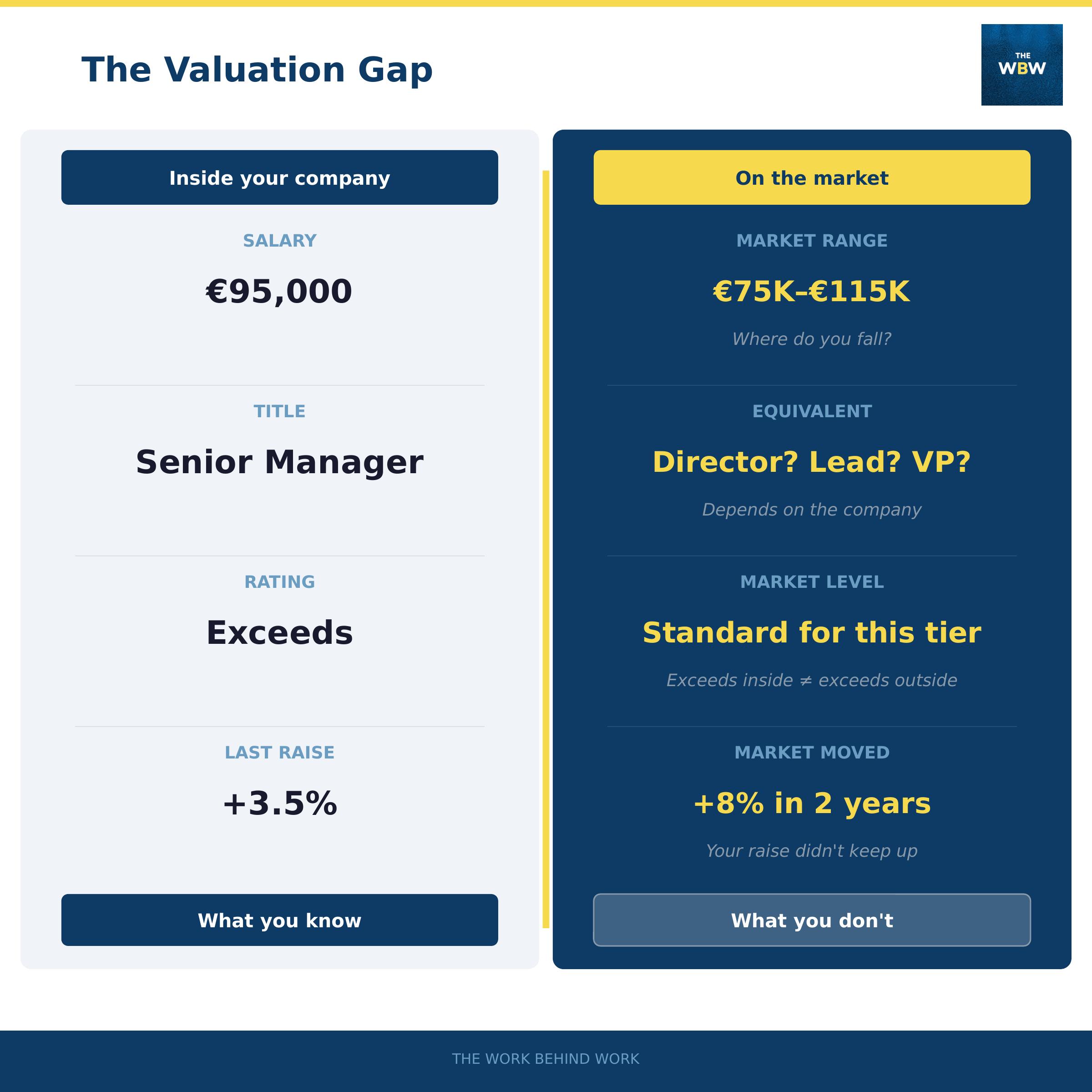
You have a number in your head. The market has a different one. The distance between the two is where careers stall.
The internal valuation
Everyone carries a sense of what they’re worth. It’s built from a mix of signals: your salary, your title, the feedback you’ve received, what you assume peers are earning, the last time someone told you “you’re doing great.”
The problem is that none of these are market signals. They’re institutional signals.
Your salary reflects what the company was willing to pay when you were hired, adjusted by whatever internal logic they apply. It does not reflect what someone else would pay today. Your title means something specific inside your organisation and something completely different at the company across the street. Your manager’s feedback tells you how they perceive your performance. It tells you nothing about how the external market values what you do.
Most professionals treat these internal signals as if they’re market data. They’re not. They’re transfer pricing. Internal numbers that serve the institution’s budgeting logic, not your actual market value.
The longer you go without testing the real number, the wider the gap can grow. In either direction.
The two gaps
The valuation gap runs both ways. Both are problems.
Overvalued. You think you’re worth more than the market would pay. This happens when your salary has been inflated by tenure, when your title carries more weight inside than outside, or when your skills have depreciated without you noticing. The correction comes when you start interviewing and the offers are lower than expected. Or when a restructuring happens and the market tells you what it actually thinks.
Undervalued. You’re worth more than what you’re currently accepting. This is more common than most people realise, especially among high performers who haven’t tested the market in years. You stayed, you grew, the market moved — and nobody inside adjusted your price because you never asked. The cost here is invisible: years of accepting below-market compensation because you never had the data to negotiate differently.
Both gaps share the same root cause. You haven’t checked the price.
The mark to market audit
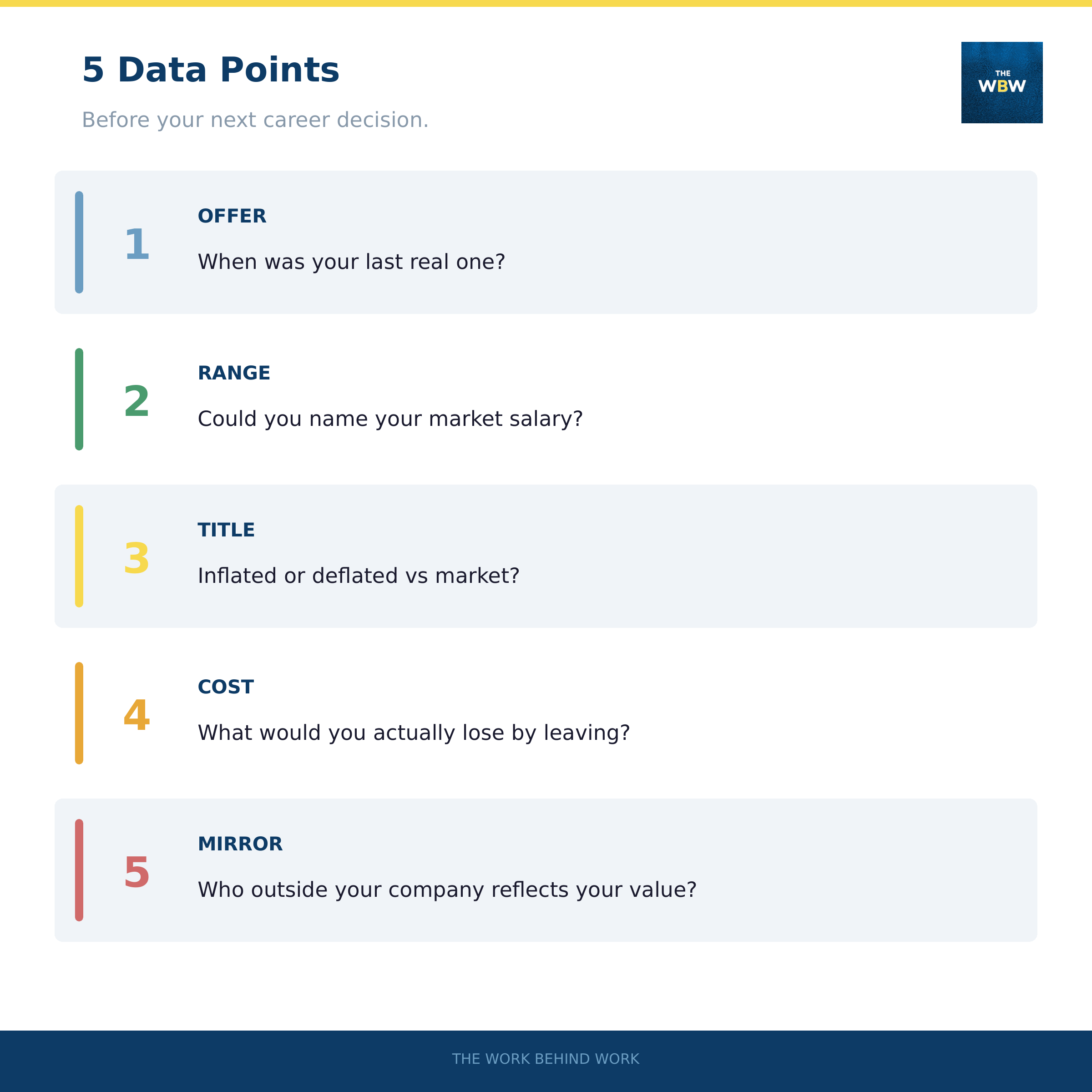
When was the last time you received a real offer from the market? Not a recruiter message. An actual offer with a number attached. If it’s been more than two years, your internal valuation is running on assumptions. The market has moved since then. You don’t know in which direction.
Could you state your market salary range right now with confidence? Not what you earn. What someone in your role, with your experience, in your geography, would be hired for today. If you can’t answer this within a 15% range, you’re negotiating blind every time compensation comes up.
Is your title inflated or deflated relative to the market? Some companies inflate titles to retain people without increasing pay. Others keep titles flat while the scope expands far beyond the label. Which one are you in? A Director at one firm and a VP at another might do exactly the same job. If you don’t know where your title sits relative to the market, you don’t know how to position yourself externally.
What would you lose if you left tomorrow that you couldn’t rebuild in 12 months? Unvested equity. A pension scheme. A specific project. Relationships that only exist inside the institution. This is your switching cost. Knowing it precisely tells you what the institution is actually paying you beyond your salary. Sometimes it’s significant. Sometimes it’s less than you think.
When was the last time someone outside your company described your value back to you? Not your manager. Not your team. Someone with no institutional reason to validate you. A peer at another firm. A recruiter who actually understands your market. A former colleague who can see your trajectory from the outside. If no one external has reflected your value recently, your self-assessment is based entirely on internal mirrors.
Scoring: Count how many of these five questions you could answer with actual data rather than assumptions.
4 to 5 with data: You know your price. You’re making informed decisions. 2 to 3 with data: Partial visibility. Some of your career decisions are based on guesswork. 0 to 1 with data: You’re flying blind. Your internal valuation has no market basis.
The repricing moves
You don’t need to leave your job to mark your career to market. You need to collect data.
Get a real market read this month. Have one conversation with a recruiter who specialises in your function and level. Not to job hunt. To calibrate. Ask them: what are companies paying for this profile right now? What skills are they prioritising? What’s moving faster than people expect? One conversation. Thirty minutes. More valuable than any internal benchmarking exercise.
Ask the uncomfortable question. Next time compensation comes up, ask your HR team or manager: how does my package compare to market benchmarks for this role? Most companies have this data. Most employees never ask for it. The question alone shifts the dynamic. It signals that you have an external reference point, whether you do or not.
Test your positioning externally. Respond to one inbound recruiter message this quarter. Not to leave. To see what the market reflects back. What do they think you’re worth? What role do they see you in? What’s the gap between how they describe you and how you describe yourself? That gap is your valuation drift.
Calculate your real switching cost. Write down everything you would lose by leaving: unvested equity, pension contributions, deferred bonus, project completion, relationships. Put a number on it where you can. This is the premium the institution is paying you to stay. If it’s large, you know what’s keeping you. If it’s smaller than you assumed, that’s important information too.
Build an external mirror. Identify two people outside your company who understand your market well enough to give you an honest assessment of your positioning. Not friends. Professionals who would tell you if you’re overpriced, underpriced, or positioned wrong. Cultivate those relationships. They’re your external auditors.
The trilogy
Liquidity asked: can the market see your value? Diversification asked: is your value structurally resilient? Mark to Market asks: is the price you carry in your head based on data or assumptions?
Together, these three form a career portfolio review. Visibility, structure, and valuation. If you’ve followed all three, you now have a clearer picture of where your career actually stands than most professionals will ever have.
This won’t be the last time we use the finance lens. Careers are assets. The tools to manage them should be just as rigorous as the ones we use to manage money.
The work behind work
In finance, an asset that hasn’t been marked to market is an asset with an unknown price. It could be worth more. It could be worth less. The uncertainty itself is the risk.
Most professionals carry a valuation of themselves that was set years ago by an institution with its own reasons for picking that number. They’ve never tested it. They’ve never updated it. They’ve never asked what someone else would pay.
The work behind work is knowing your price before someone else sets it for you.
This is the work behind work.
Kenza
This is the final edition in the finance trilogy: Liquidity, Diversification, Mark to Market. The Career Checkpoint Playbook has 21 diagnostic tools across four career checkpoints.