
The Expertise Ceiling
When the thing that made you valuable stops protecting you

You spent years becoming the person who knows. The one they call when the model breaks, when the brief needs rewriting, when the risk needs mapping. You built your career on depth. And it worked.

Then, sometime in the last twelve months, something shifted. The task that used to take you two days now takes a tool ten minutes. Nobody said anything. But the questions started going elsewhere. The team got a little smaller. The meeting got a little shorter.
It’s February. You’re tired. Your bonus hasn’t landed. And underneath the noise, a quiet realisation is forming: the thing that made you indispensable might be the thing that’s making you invisible.
Your expertise didn’t disappear. Your monopoly on it did.
The expertise ceiling
You’ve spent the last few weeks doing real work on yourself. You built your narrative. You noticed how trust reshaped your role. You processed the outcome without letting it become your identity.
Now the landscape around you is shifting. And it’s not personal.
AI is compressing the value of isolated expertise faster than most professionals realise.
The engineer who designed layouts that took two days. AI generates options in minutes. The HR manager who wrote job descriptions from scratch. AI drafts them before the briefing call is over. The supply chain planner who spent hours mapping vendor risk. AI flags the exposure in seconds.
These people are still needed. But the time they used to fill is shrinking. And when the time shrinks, the headcount question follows.
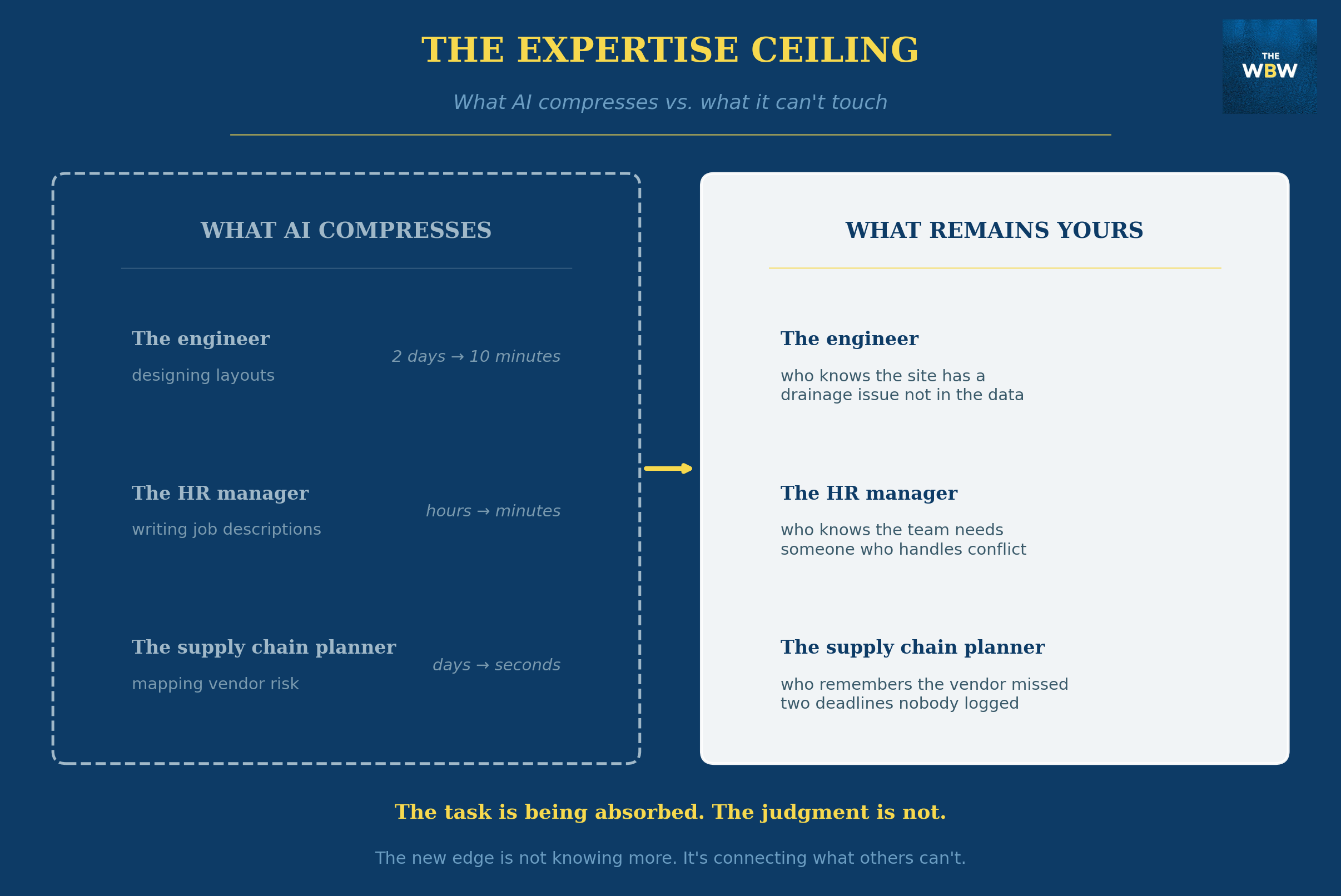
What’s left is the part that was never about the task.
The engineer who says “this won’t work because the site has a drainage issue that isn’t in the data.” The HR manager who knows the hiring manager actually needs someone who can handle conflict, not just match the job spec. The supply chain planner who tells procurement “this vendor looks fine on paper but they missed two deadlines last year and nobody logged it.”
The new edge is not knowing more. It’s connecting what others can’t.
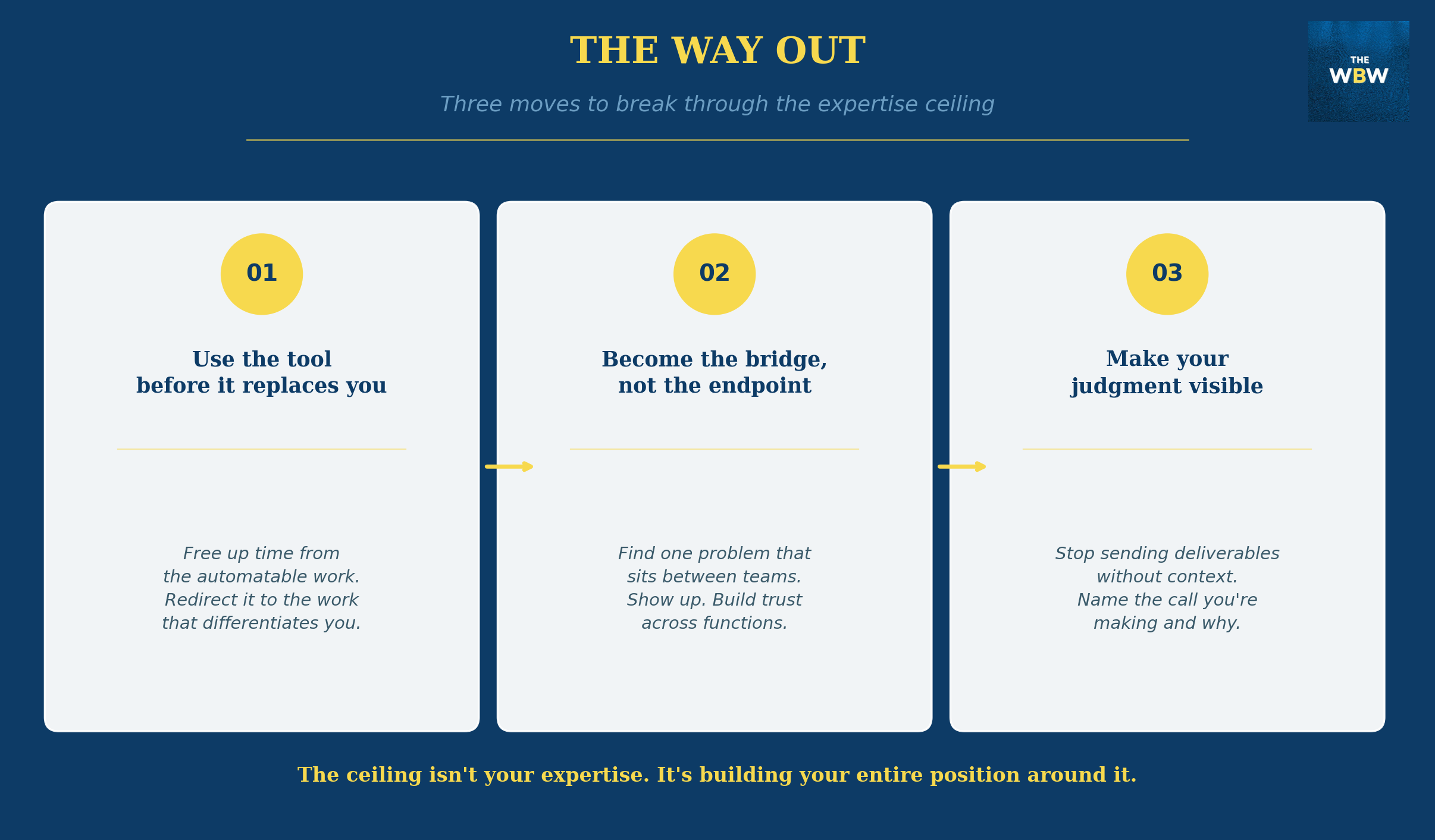
The way out
The ceiling isn’t your expertise. It’s building your entire position around it.
1. Use the tool before it replaces you
Learn the AI tools in your function. Properly. The person who uses the tool to do specialist work in two hours instead of two days doesn’t lose their role. They free up time for the work that actually differentiates them.
Example: “I started using AI to draft vendor risk reports. It handles 80%. I now spend that time in conversations with procurement leads, building context no tool has access to.”
2. Become the bridge, not the endpoint
Functions get restructured. The people who survive it are the ones who are useful across boundaries. Find one business problem that sits between teams. Show up. Build trust with one person in an adjacent function. Not networking. Working on something real together.
Example: “Client onboarding was slow and nobody owned it end to end. It touched legal, operations, and sales. I joined the weekly sync. Within a month, people came to me because I understood all three sides.”
3. Make your judgment visible
AI can do the task. It can’t explain why the output is wrong in this specific context. Stop sending deliverables without context. Name the call you’re making and why.
Example: “I now add two lines to every output: here’s what the model says, and here’s what I’d recommend given what I know about this client. That distinction is what keeps me in the room.”
Why this matters
Your company won’t send you a memo telling you your specialisation lost value. You’ll just notice. The meetings. The team size. The questions going somewhere else. Or to a tool.
Specialisation got you here. Alone, it won’t keep you relevant. And the shift is not coming. It already started.
The work behind work isn’t only being the expert. It’s becoming the person who connects what the experts can’t.
This is the work behind work.
Kenza