
The Mismatch
The career blind spot that looks exactly like stability

Something shifted and I don’t think enough people felt it. A quiet line between the world before and the world after. If you’re building your career the same way you were three years ago, you’re building for a world that’s already gone.

The biggest risk in your career right now isn’t a bad manager or a missed promotion. It’s optimising for a world that’s already gone.
The old playbook
For years, the career strategy was clear. Build expertise. Become the go-to person. Protect your position. Make yourself indispensable through what you know.
And it worked. Because knowledge was hard to access. Experience took time. Being the person who knew the thing was valuable because not many people could.
So people did the logical thing. They reached a level and stayed there. They spent years marketing that expertise, protecting it, building their whole professional identity around it. “I’m the person who does X.” It brought comfort. Clarity. Status. And for a long time, it was the smart move.
But the world before 2022 and the world after 2022 are not the same world.
AI didn’t just change the tools. It changed how fast anyone can learn anything. The staircase that used to take years to climb? It’s faster now. The field of what’s possible has exploded. And the person who built their entire career around one step? They’re not standing on a strong foundation anymore. They’re standing still while everything around them moves.
That’s the mismatch. Not between you and your company. Between the speed the world is evolving and the speed you’re evolving with it. And it doesn’t feel like a problem. It feels like stability. It feels like “I’m good at my job.”
I don’t trust fine anymore.
What I learned
Every time I got good at something, I didn’t stay there. I went deeper, shared what I knew with my team, and started building the next layer on top of it. Financial services fed into strategic thinking. Strategic thinking fed into go-to-market. Each layer made the previous one richer.
People thought I was crazy. “You just got to a level, why are you already moving?” Because I never saw skills as a destination. I saw them as a staircase. You learn, you go deep, you share it, you build the next step from a higher place. I didn’t abandon what I built. I built on top of it.
And that’s the difference right now. Being defined by your expertise makes you protective. Being fuelled by it makes you curious. One keeps you on the same step. The other uses it as a launchpad.
The check
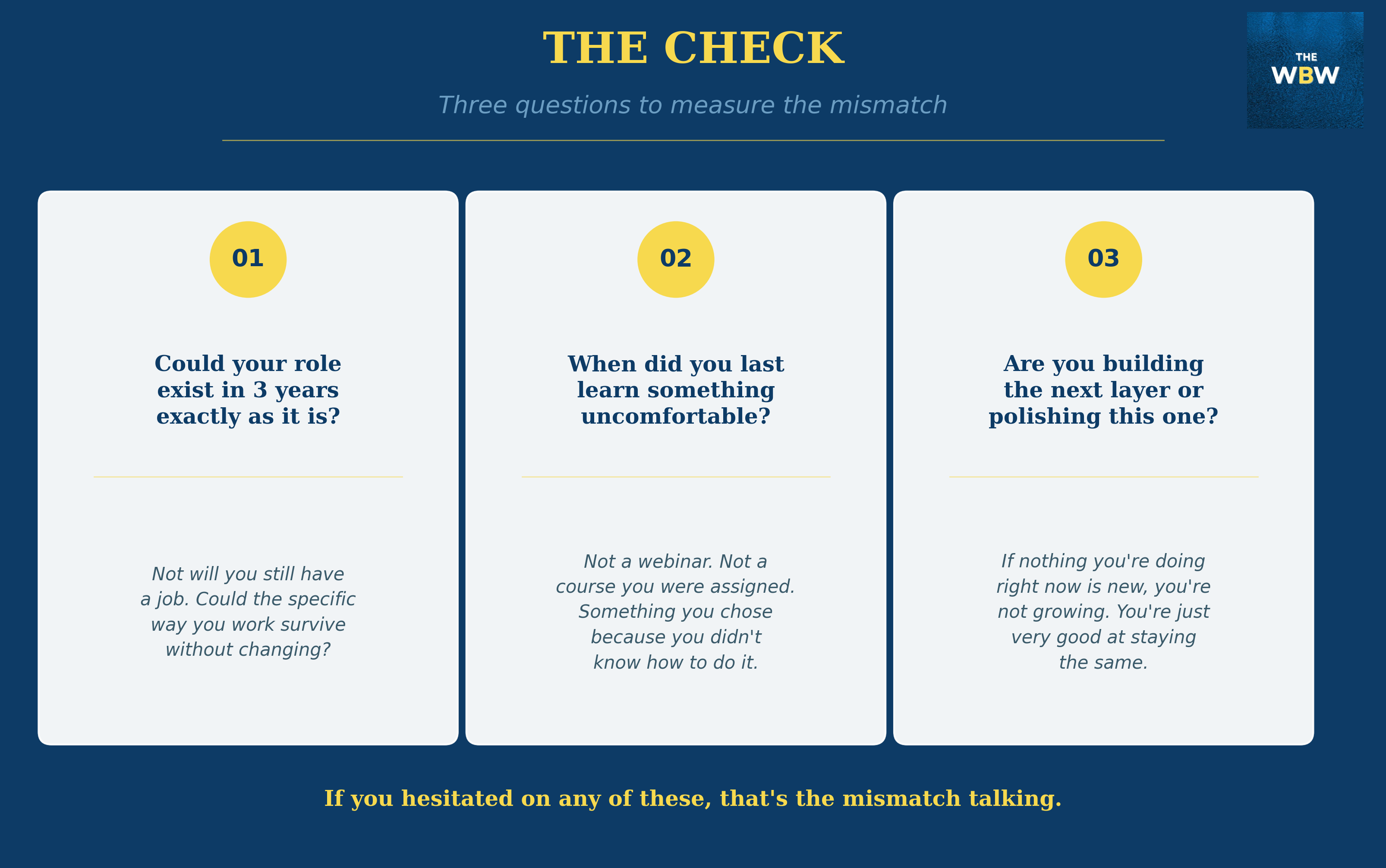
1. Could your role exist in 3 years exactly as it is today?
Not will you still have a job. Could the specific way you do your work survive three more years without changing? If you hesitate, that hesitation is the mismatch.
“I asked myself this and the honest answer was no. Not because I’ll be fired. Because the way my entire industry makes decisions is shifting. The role will exist. But it won’t look like what I’m doing now.”
2. When was the last time you learned something that made you uncomfortable?
Not a webinar. Not a course your company assigned. Something you chose because you didn’t know how to do it. Something where you were the worst in the room. If it’s been more than a year, you’re standing on the same step.
"The moment I started feeling comfortable is the moment it got scary. Not because anything went wrong. Because I could feel the rhythm of my work slowing down while the world outside was speeding up. That gap between the two is what made me move."
3. Are you building the next layer or polishing the current one?
There’s a difference. Polishing feels productive. You’re refining, optimising, getting sharper at what you already do. But if nothing you’re doing right now is new, you’re not growing. You’re just becoming a better version of the same step. And in a world that’s adding new floors every day, that’s not enough.
"I was delivering great work. Getting good feedback. But I kept looking around and thinking: the world outside this company is moving so much faster than anything we're doing in here. I wasn't unhappy. I was restless. And I think that restlessness was trying to tell me something."
The moves
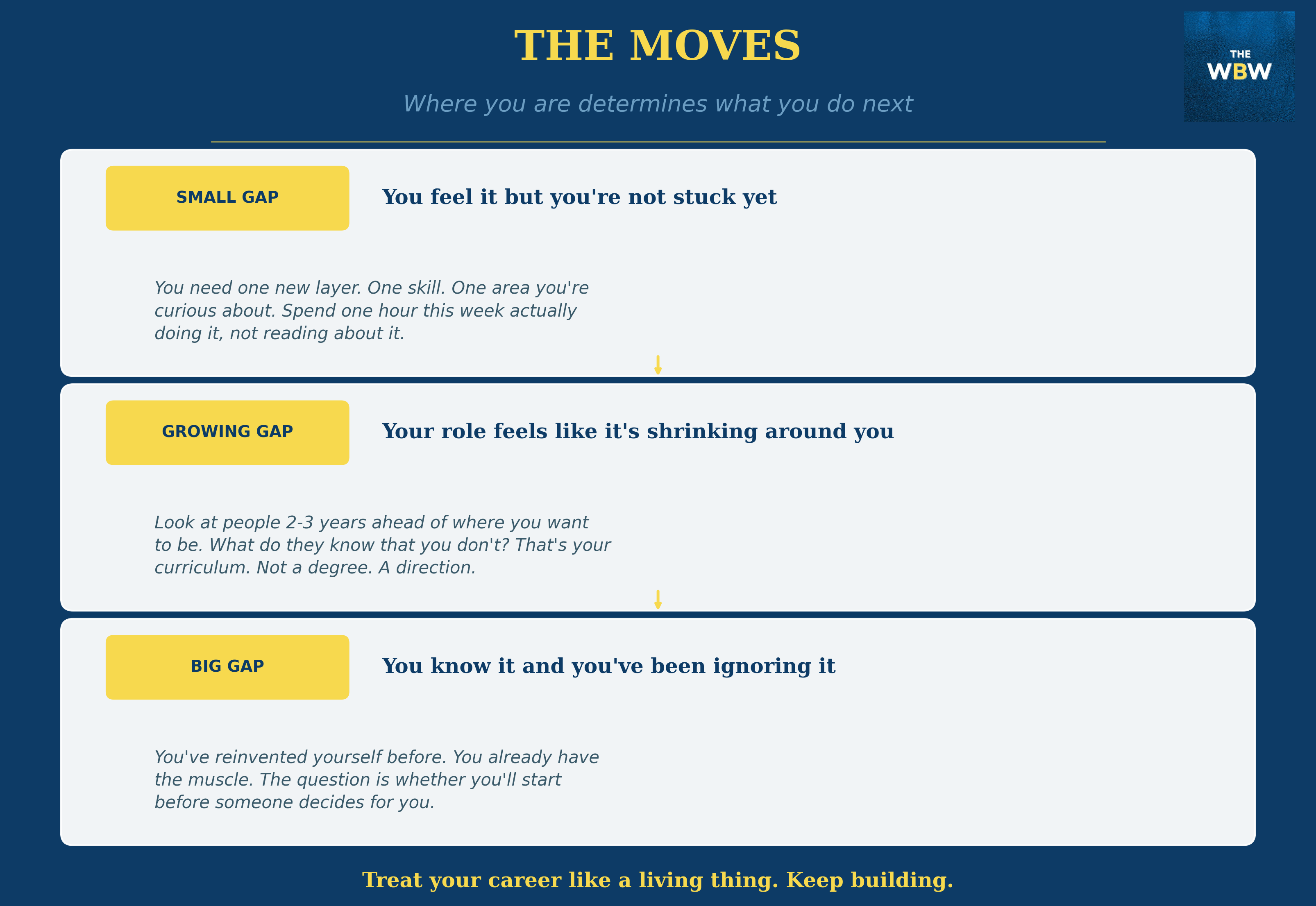
If the mismatch is small, you feel it but you’re not stuck yet:
You don’t need a career overhaul. You need one new layer. One skill you don’t have yet. One area you’re curious about but keep putting off. Not to abandon what you’ve built. To build on top of it.
Try this: The thing in your industry you keep hearing about but haven’t properly explored. Spend one hour this week actually doing it. Not reading about it. Trying it. The gap between “I’ve heard of it” and “I’ve tried it” is where the mismatch starts closing.
If the mismatch is growing, your role feels like it’s shrinking around you:
The version of you that built this career is not the version that builds the next one. That doesn’t mean starting over. It means the foundation you have is exactly what the next layer needs. But you have to actively build it instead of waiting for a development plan that’s never coming.
Try this: Look at the people in your industry who are 2-3 years ahead of where you want to be. What do they know that you don’t? What layer did they build that you haven’t? That’s your direction.
If the mismatch is already a problem, you know it and you’ve been ignoring it:
You’ve reinvented yourself before. New job. New team. New everything. You didn’t start from zero those times and you won’t now. Everything you’ve built is still under you. The question isn’t whether you can build the next layer. It’s whether you’ll start before someone decides for you.
Try this: Finish this honestly: “The career I’m building right now is leading me towards ___.” If you can’t finish it, that’s not a crisis. That’s clarity. Now you know where to start.
The work behind work
The world changed. The staircase changed. The only thing that hasn’t changed is your ability to climb it.
You didn’t build what you’ve built to stay on one floor. You built it because that’s what you do. You learn, you grow, you build the next thing. And right now the field of what’s possible has never been wider. There has never been more room to grow, to reinvent, to stack a new layer on everything you already know. But it won’t happen by polishing the same step.
The work behind work isn’t just playing the game well. It’s making sure the game you’re playing still exists.
This is the work behind work.
Kenza